
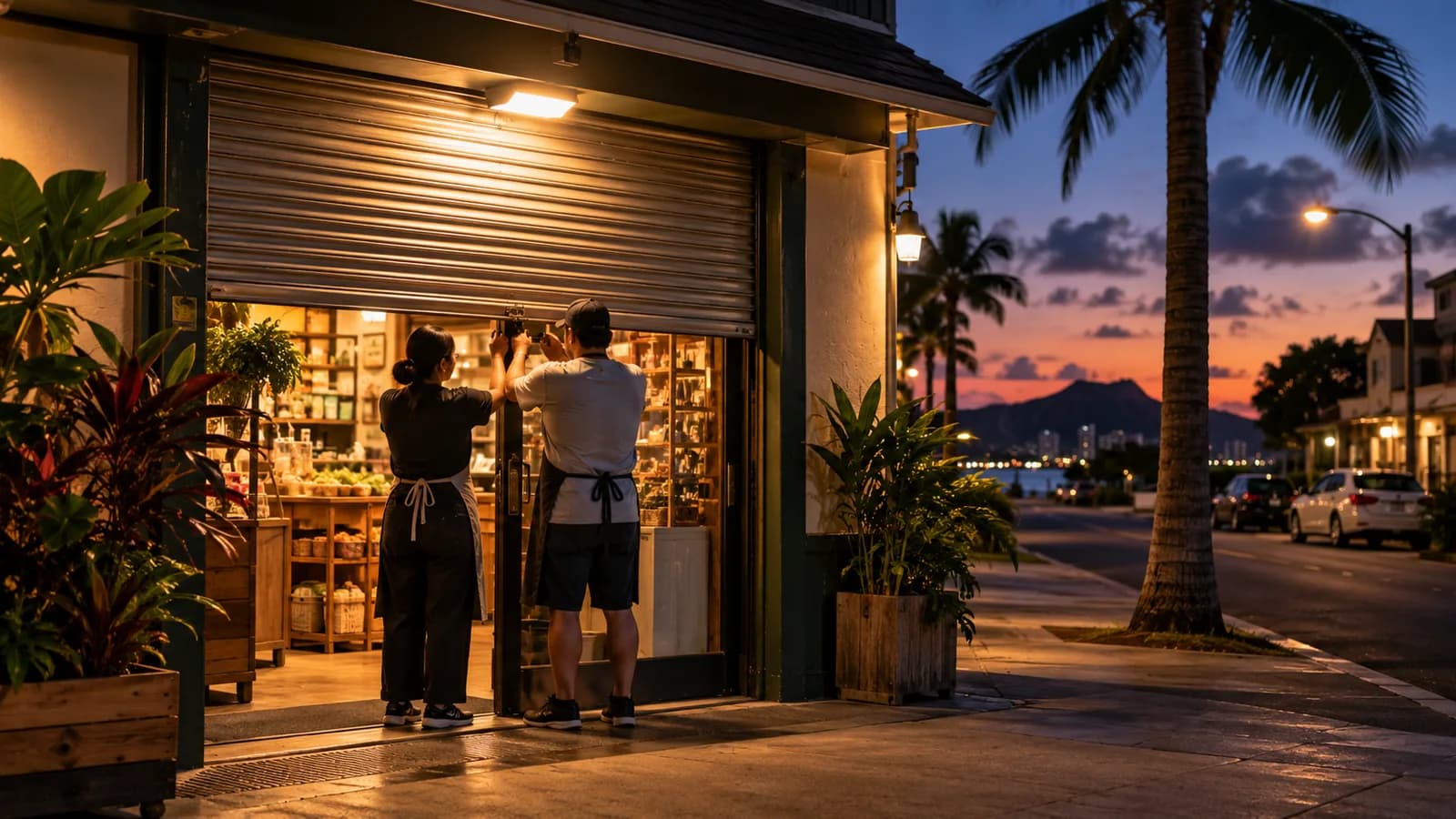
The safest way to close a small business in Hawaii is to follow the same written routine every night: close with two people whenever possible, keep cash counts out of sight and deposits unpredictable, keep the entrance and parking area well lit, confirm cameras and the alarm are working, and walk to cars together. Give every staff member a clear plan for what to do if something feels wrong, and make it clear that no one should ever use force to protect money or merchandise. Less-lethal tools can be part of a business owner's plan, but they come after these basics, not instead of them.
Build a two-person closing routine
Most closing-time risk comes from being alone, distracted, and predictable. A two-person close addresses all three.
- Schedule two people for every close when staffing allows. One person handles the register and lockup while the other keeps an eye on the door and lot.
- Lock the door at closing time. Do not let "just one more customer" in after you have started counting.
- Check the space before you count. Walk restrooms, back rooms, and storage areas to make sure no one is still inside.
- Keep the back door closed. Taking out trash after dark is a common moment to be caught off guard. Do it before closing, or with two people.
- Write it down. A one-page closing checklist posted in the back room makes the routine the same no matter who is on shift.
Handle cash carefully
Cash is the reason many after-hours problems start, so the goal is to keep less of it around and make its movement hard to predict.
- Count out of view. Close blinds or move to a back office rather than counting at a register that faces a window.
- Drop cash through the day. Use a safe during the shift so the drawer never builds up.
- Vary deposit times and routes. Avoid walking the same bank bag to the same place at the same time.
- Set a clear rule. If someone demands money, staff hand it over. Cash and merchandise can be replaced. People cannot.
Lighting, cameras, and alarms
Good visibility helps staff see what is around them and helps everyone outside see in.
- Light the entrance, back door, and parking area. Replace burned-out bulbs quickly and trim plants that block light.
- Leave some interior lights on after closing so the inside of the shop is visible from the street.
- Check cameras regularly. Make sure they cover the register, doors, and lot, and that recordings are actually saving.
- Arm the alarm every night. Make sure each closer knows the code and what to do if it trips.
Walking to cars together
The walk from the door to the car is where closers are most exposed.
- Leave together and wait together. No one drives off until everyone's car has started.
- Keys in hand before the door is locked.
- Scan the lot before stepping out. If someone is waiting near cars, stay inside, lock up, and call for help.
- Keep a personal alarm on the key ring. The Byrna Banshee ($35) is a 130dB personal safety alarm with a carabiner, and an easy item for every closer to carry.
You can browse more options in the shop or see current bundles.
Give staff a clear plan
Walk new hires through the plan before their first closing shift.
- Leave and call 911. If something feels wrong, staff should leave, lock themselves in a back room, or go somewhere with people, then call 911.
- Never chase anyone. Staff should not follow a shoplifter or a person who took cash.
- Know the exits. Every closer should know at least two ways out.
- Report and write it down. After any incident, record what happened, check that cameras saved it, and let the owner know.
- Check in. Owners who are not on site can ask closers to send a quick text once they are safely in their cars.
Where less-lethal tools fit, and the limits on force
Whether a business keeps any self-defense tools on site is the owner's own decision, and it should come after the routines above. A tool is the last layer, after awareness, distance, leaving, and calling 911.
According to our Hawaii laws guide, Byrna and PepperBall® CO2 launchers are not classified as firearms in Hawaii and can be bought without a permit by people 18 and older. Electric guns such as TASER devices are legal to own, but the buyer must be 21 or older and buy in person at the dealer's store, with a background check, a signed declaration, and a safety briefing. They are never sold online.
Some options owners look at:
- Byrna launchers, such as the Byrna SD Universal Kit - Self Defense ($415), a .68 caliber launcher with a 60-foot range.
- Handheld pepper launchers, such as the Blast Stick Live X ($53), with a 10 ft effective range, plus the Inert Blast ($50) for practice.
- TASER devices, such as the Taser Pulse 2 ($450), a compact device with a 15-foot range, sold in store only.
Do not make property worth a confrontation. Merchandise and cash can be replaced, and a store policy of letting it go keeps staff out of harm's way. The Hawaii laws guide summarizes HRS 703-304 this way: you may use force when you reasonably believe it is immediately necessary to protect yourself against unlawful force, and the force must be proportional to the threat. It also notes that the no-duty-to-retreat rule of the limited Castle Doctrine applies in your own dwelling, and a shop is not that. A shoplifter walking out with merchandise is not a reason to reach for a device.
If you are thinking about tools for your business, get legal advice for your specific situation, including any policies you set for employees. This is general information, not legal advice. Check our Hawaii laws guide or a licensed attorney.
You can see options in person at 1773 S King St, where the shop offers hands-on demos, or contact us with questions.
Frequently asked questions
What is a two-person close?
A two-person close means at least two staff members are present for lockup, cash handling, and the walk to cars. One focuses on closing tasks while the other watches the door and surroundings.
Should employees try to stop a robbery or shoplifter?
No. Staff should hand over cash if it is demanded, never chase anyone, get to safety, and call 911. Property can be replaced.
Can a Hawaii business owner keep a Byrna launcher at the shop?
Byrna CO2 launchers are not classified as firearms in Hawaii and can be bought without a permit by people 18 and older, according to the store's Hawaii laws guide. Get legal advice before setting any policy for your business.
Does the Castle Doctrine apply to my store in Hawaii?
The store's Hawaii laws guide says Hawaii's Castle Doctrine applies only to your dwelling, not your vehicle or place of business. This is general information, not legal advice.
Can I buy a TASER online for my business in Hawaii?
No. Electric guns must be bought in person at a licensed dealer's premises by someone 21 or older, with a background check, signed declaration, and safety briefing.